
What Makes a House Iconic?
SPECIAL - Best of Belgium
Restoring Richard Meier’s Douglas House
A new chapter for Richard and Su Rogers’ 22 Parkside
Home of the Future, 1925–1985: Designing Domestic Utopias at LACMA
Aalto Works Series Inscribed on the UNESCO World Heritage List
SPECIAL - Casas Icónicas en España!
Volten - Exhibition on Post-war Dutch Collective 'Liga Nieuw Beelden'
Breuer, Goldfinger and Other Hungarians
Icon for Sale: Villa Guna
City Icons Barcelona - Photo Gallery
Casa Moratiel Opens to the Public
Casa Rovira Guesthouse – Special Stay Offer
The Spirit Of Gaudí
Paolo Sustersic - At Home in Barcelona: City Living Reimagined
Architectural Conservation Trust Launched
SPECIAL –Inside Italy’s Most Iconic Houses
Iconic Encounters: Glasgow's Charles Rennie Mackintosh
SPECIAL – Women & Iconic Houses
The Humanism of Charlotte Perriand
Villa Beer opened 8 March 2026
Inside UNESCO Icons: Houses That Made History - Part 1
Inside UNESCO Icons: Houses That Made History - Part 2
Czech It Out: A Stylish Soirée of Exhibition and Film
Sopot Hosts Icons of Czech Avantgarde Exhibition
Pioneers of the Dutch Modern House - Film Screenings
Iconic Encounters: Barcelona
SPECIAL – Austria
SPECIAL – Czech Classics
SPECIAL - Vacances en France!
SPECIAL – Iconic Dreams Europe
SPECIAL – Iconic Dreams North America
Tautes Heim. Story & Details
Casa Gomis acquired by Spain's Ministry of Culture
Our Badge of Honour
New Year's Reception and Eileen Gray Screening
Funding Win Marks Anniversary of Mackintosh Acquisition
Modernist Houses Lost in the LA Wildfires
Casa d’Abreu Neto: Siza’s First Work
Pioneers of the Dutch Modern House
Iconic Encounters: London
Interview in Leading Catalan newspaper ARA
Record Number of New Iconic Houses - Part 1
Record Number of New Iconic Houses - Part 2
At Plečnik House: To Decide Where the Shadow Falls
A Story of Burnt Books and Broken Bricks
Remembering Irving J. Gill
Iconic Houses in the Media in 2024
Bauhaus Villa in Berlin For Sale
Historical Exhibition, Marie-Laure de Noailles, Painter, Conversation
Mackintosh’s Hill House Becomes an International Iconic House!
Istanbul’s Modernist Ataköy Housing Estate is At Risk
Early Furniture Designs by Le Corbusier on Permanent Display in Maison Blanche
Photo Report City Icons Amsterdam
Healing Through Architecture
Reopening An Iconic Modernist Landmark
City Icons Kick Off with Talk by Linda Vlassenrood
MORE MIES - Pure Architecture in Haus Lange Haus Esters
Through a Bauhaus Lens: Edith Tudor-Hart and Isokon
Modernism Week Lecture: 12 Years of Iconic Houses
Aluminaire House Grand Opening
Exhibition Icons of the Czech Avant-Garde
An Elementalist and Mediterranean Architecture
Icon for Sale - Loos Villa: Haus Horner
SPECIAL – UK Originals
SPECIAL – Dutch Delights!
SPECIAL – German Greats!
SPECIAL – Northern (High)Lights!
SPECIAL – Iconic Collective Housing
SPECIAL – Iconic Artist Residencies
Support the Frankfurt Declaration (on Housing)
Winy Wants a World Wonder
Welcome Atelier Volten!
Sleep in a Modernist Gem – Huis Billiet in Bruges
Iconic Houses in The Netherlands - 100 Years Van Zessen House
Exclusive Tour and Film Screening Package
The Last House Designed by Adolf Loos Will Be Built in Prague
Icons of the Czech Avantgarde
Icon for Sale - Casa Legorreta
Rietveld Day: 200 Enthusiasts Explored 3 Utrecht Icons
Hurray! 10 Years Iconic Houses
7th International Iconic Houses Conference A Huge Success
Meet Conference Co-Chair Iveta Černá
Meet Conference Co-Chair Maria Szadkowska
Eighteen Iconic Houses Under One Roof
17 June - 'Pioneers-film' Screening Amersfoort
Iconic Houses in The Netherlands - Van Eesteren House Museum
Welcome Margarete Schütte-Lihotzky Zentrum in Vienna!
Welcome Vila Volman! Jewel of Czech Functionalism
Movie Night: Adolf Loos- Revolutionary Among Architects
'Inside Iconic Houses' Case Study House #26 Webcast in Webshop
Inside Iconic Houses at Taut’s Home in Berlin
Rediscovering Forgotten Loos Interiors in Pilsen
'Inside Iconic Houses' - Online Tour Program
Iconic Houses in The Netherlands - The Diagoon House
Iconic Houses in The Netherlands - Rietveld Schröder House
Rietveld Houses Owners Association
Corberó Space: New Life for Hidden Jewel
Iconic Houses in The Netherlands - Pierre Cuypers' House and Workshops
Reeuwijk Celebrates Completion of Restoration Rietveld Homes!
Iconic Houses in The Netherlands - Van Doesburg Rinsema House
Welcome Rietveld's Van Daalen House!
Architect Harry Gessner Passed Away at 97
Watch Pioneers of the Dutch Modern House Now On Demand
Icon Saved: Dorchester Drive House
Iconic Houses in the Netherlands – Berlage’s Masterpiece
Iconic Houses in The Netherlands - Het Schip
Inside Iconic Houses - Tour of Maison Cazenave
Inside Iconic Houses Tours Vizcaya Museum & Gardens in Miami
Casa Masó Celebrates 10 Year Anniversary
Inside Iconic Houses tours Roland Reisley's Usonian Frank Lloyd Wright House
Rietveld’s Experimental Housing in Reeuwijk Saved
Serralves Villa after restoration
Portraits of the Architect - Interview with Gennaro Postiglione
Test Labs for New Ideas - Interview with Natascha Drabbe
Inside Iconic Houses - Isokon Building
Inside Iconic Houses - 16 December: Sunnylands with Janice Lyle
BCN-BXL Coderch-De Koninck - Beyond Time
New Chairman Architect Nanne de Ru on The Perfect Platform
Health and Home - Interview with Beatriz Colomina
A Life Less Ordinary – Interview with Valentijn Carbo
Invisible Women - Interview with Alice T. Friedman
Winy Maas on the Green Dip
Anita Blom on Experimental Housing of the 1970s
Women’s Worlds - Interview with Natalie Dubois
The Culture of Living - Interview with Robert von der Nahmer
Hetty Berens: A Fresh Take on Modernism
Niek Smit on Supporting Modern Heritage
Alice Roegholt on Amsterdam’s Working-Class Palaces
July is Iconic Houses Month
Hans van Heeswijk on The Pioneers of the Dutch Modern House
Wessel de Jonge on Dutch Icons at Risk
Save Maison Zilveli - Sign the Petition!
How a Building Tells a Story - Recorded Event
Toolkit for Owners of a Modern House
13 Aalto Sites Nominated for UNESCO World Heritage
Villa Beer At Risk - Sign the Petition!
Business Cards of Stone, Timber and Concrete in the Brussels Region 1830-1970
Exhibiting & Visiting Modernist Monuments
Fostering Well-Researched Responsible Design
ICONS AT RISK
Enjoy a virtual visit to the California House and a Q&A with architect Peter Gluck
Exhibition 'Modernism and Refuge'
A Hidden Gem of Postmodernism
New Centre for Historic Houses of India
An Online Chronicle of the Douglas House
Villa Henny, geometric style icon in The Netherlands
A Mendini temple in Amsterdam
IH-lectures USA & Canada Feb 2020 on Melnikov House
Sponsors and Friends
An Afternoon with the Glucks
Chandler McCoy on Making Modern Houses Sustainable
Catherine Croft: Getting Away from the Demolition Mentality in the UK
Patrick Weber on Discovering an Unknown Icon
Fiona Fisher on Iconic Interiors
Jocelyn Bouraly on Villa Cavrois
Mireia Massagué on finding success through a new kind of partnership
Danish Moderns – Looking Back at Our Mini-Seminar
Venturo house complements Exhibition Centre WeeGee’s offering
Lecture report: Remembering Richard Neutra
Hôtel Mezzara and the Guimard Museum project
We welcome 13 new members!
BREAKING NEWS: 8 Wright Sites Inscribed on Unesco World Heritage List!
LECTURE 29 August - Raymond Neutra: My Father and Frank Lloyd Wright
Iconic Reads
Iconic Houses End Year Message
City-ordered rebuild of landmark house stirs debate: Appropriate or overreach?
Kohlberg House Restoration in Progress
Planned Demolition of Rietveld Homes in Reeuwijk
Renovation Gili House in Crisis
An Iconic Saga
Restoring Eileen Gray’s Villa E-1027 and Clarifying the Controversies
Modernism on the East Coast
Iconic Houses in Latin America
Conference testimonials
House Tours May 2018
Expert Meetings
Natascha Drabbe - Iconic Houses: The Next Chapter
Terence Riley -KEYNOTE SPEAKER- on Philip Johnson
New era for Villa E-1027 and Cap Moderne
Hilary Lewis on Philip Johnson and his Glass House
John Arbuckle on Great House Tours
William D. Earls on the Harvard Five in New Canaan
Stover Jenkins on Working for Philip Johnson
Frederick Noyes on his Father’s House
Scott Fellows and Craig Bassam on their Passion for Preservation
Jorge Liernur -KEYNOTE SPEAKER- on Latin American Modernism(s)
Fabio Grementieri on Modernism in Argentina
Catalina Corcuera Cabezut on Casa Luis Barragán
Renato Anelli on Lina Bo Bardi’s Casa de Vidro
Tim McClimon on Corporate Preservation
Amanda Nelson on Building Donor Relationships
John Bacon on Planned Giving
Jean-Paul Warmoes on the Art of Fundraising in America
Chandler McCoy on Why Less is More
Katherine Malone-France on Moving with the Times
Anne Mette Rahbæk on Philanthropic Investments and Preservation
Peter McMahon on Saving Modern Houses on Cape Cod
Toshiko Kinoshita on Japanese Modern Heritage Houses
Roland Reisley on Life in a Frank Lloyd Wright House
5th Iconic Houses Conference May 2018
Kristin Stone, Pasadena Tour Company
Restoring the past: The Diego Rivera and Frida Kahlo Home Studio
Behind the Scenes: Hendrick de Keyser Association
Crosby Doe, Architecture for Sale
Latin America Special – Focus on Mexico
De Stijl in Drachten
Preserving the Nancarrow House-Studio
Meet the Friends - Nanne de Ru
Latin America Special – Focus on Brazil
Jan de Jong’s House is Latest Hendrick de Keyser Acquisition
Stay in a Belgian Modernist Masterpiece
In Berlin’s Modernist Network
Rietveld-Schröder House Celebrates De Stijl Anniversary
Meet Our New Foundation Board Members
Maintaining Aalto's Studio – Linoleum Conservation
Virtual Tour of a Papaverhof Home in 3D
Getty Grant for Villa E-1027
Plečnik House in Ljubljana
Iconic Dacha
Iconic Houses: A Bohemian Road Trip
Work in Progress: Capricho de Gaudí
11 Le Corbusier Homes now on Unesco World Heritage List
At home with Le Corbusier
Henry van de Velde’s Study in Haus Hohe Pappeln Restored
Lynda Waggoner reports
A Conference to Remember
4th International Iconic Houses Conference
Guest of Honor - Harry Gesner
Fallingwater: European Lecture Tour
Wright Plus 2016 Walk
Susan Macdonald, Getty Conservation Institute
John Mcllwee, Garcia House
Meet the Friends – Elisabeth Tostrup
Iconic Houses: The Story So Far
Willie van Burgsteden, designer Iconic Houses
Buff Kavelman, Philanthropic Advisor
Meet the Friends - Frederick Noyes
Sheridan Burke, GML Heritage
Meet the Friends - Raymond Neutra
Sidney Williams, Frey House
Franklin Vagnone and Deborah Ryan, Museum Anarchists
Meet the Friends - James Haefner
Toshiko Mori, architect
Malachi Connolly, Cape Cod Modern House Trust
Meet the Friends - Penny Sparke
Lucia Dewey Atwood, Eames House
Cory Buckner, Mutual Housing Site Office
Jeffrey Herr, Hollyhock House
Speaking Volumes: Building the Iconic Houses Library
Sarah Lorenzen, Neutra VDL Studio and Residences
Ted Bosley, Gamble House
Keeping It Modern - Getty Conservation Grants
Meet the Friends - Thomas Schönauer
Wim de Wit, Stanford University
Linda Dishman, Los Angeles Conservancy
Jesse Lattig, Pasadena Heritage
Join us in Los Angeles! Update
Work in Progress: Casa Vicens
Work in Progress: Van Wassenhove House
Work in Progress: Villa Cavrois
Work in Progress: The Pearlroth House
Conference calls!
Follow us!
Third Iconic Houses Conference a huge success
Conference House Tours Barcelona
Marta Lacambra, Fundació Catalunya-La Pedrera
Natascha Drabbe, Iconic Houses Foundation
Special speaker Oscar Tusquets
Jordi Tresserras, UNESCO Network ‘Culture, tourism and development’
Christen Obel, Utzon Foundation
Elena Ruiz Sastre, Casa Broner
Fernando Alvarez Prozorovich, La Ricarda
Tim Benton, Professor of Art History (Emeritus)
Susana Landrove, Docomomo Spain
Rossend Casanova, Casa Bloc
Icon at Risk: Casa Gomis / La Ricarda
Conference Program 25 November 2014
Jordi Falgàs, Casa Rafael Masó
Documentary La Ricarda
Marga Viza, Casa Míla/La Pedrera
Celeste Adams, Frank Lloyd Wright Trust
Conference 25 November 2014 at La Pedrera
Henry Urbach, The Glass House
Victoria & Albert Museum London November 12, 2013
Tommi Lindh, new director of the Alvar Aalto Foundation and Museum
Iveta Černá, Villa Tugendhat
Lynda Waggoner, Fallingwater
Kimberli Meyer, MAK Center
Rent a house designed by Gerrit Rietveld
Barragán House on Screen
Gesamtkunstwerk – An Icon on the Move
Triennale der Moderne 27 September - 13 October 2013
Prestigious Art Nouveau mansions in Brussels open
September 14 + 15: Heritage Days in Paris
June's New Arrivals: Museum Apartments
Iconic Houses is now on Twitter and Facebook
Corbu’s Cabanon: Reconstruction and Lecture
Projekt Mies In Krefeld: Life-sized model of the Krefeld Clubhouse
New arrivals: Spain special
MAMO: Le Corbu’s ‘Park in the Sky’ open 12 June
Taut's Home wins Europa Nostra Award
Annual Wright Architectural Housewalk: 18 May
Frank Lloyd Wright Homes on Screen
Message from the Editor
Neutra’s House on Screen
Michel Richard, Fondation Le Corbusier
Symposium The Public and the Modern House
Melnikov House on Screen
Iconic Houses in the media
Message from the Editor
Round Table Review
Eileen Gray House on Screen
Copy Culture
At Home in the 20th Century
New 20th century Iconic Houses website launches
Philippe Bélaval, Centre des monuments nationaux
The Humanism of Charlotte Perriand
Kunstmuseen Krefeld Highlights a Remarkable Oeuvre
Charlotte Perriand was more than just Le Corbusier’s collaborator; she was a visionary architect and designer with an impressive body of work. Her practice ranges from the chair to the city and is driven by a profound sense of humanism. According to Harm Tilman, an exhibition in Krefeld on her diverse oeuvre demonstrates that her people-centred design approach is more relevant today than ever.
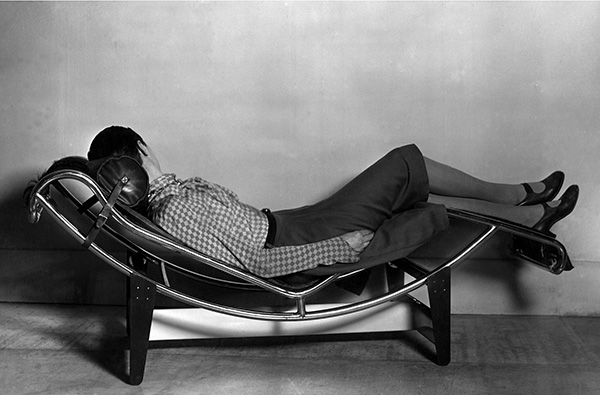
| Charlotte Perriand reclining on the Chaise Longue, designed by Le Corbusier, Pierre Jeanneret, and Charlotte Perriand, Archives Charlotte Perriand, Image VG Bild-Kunst, Bonn, 2025. |
By Harm Tilman
Charlotte Perriand’s career (1903–1999) spanned more than 60 years, yet she is best known to the public for her collaboration with the French architect Le Corbusier. In 1927, she was hired by his architectural office, where she led the interior design department for ten years. Together with Le Corbusier and his cousin Pierre Jeanneret, Perriand designed four pieces of furniture that are now considered design classics.
There is something peculiar about these objects (Chaise Longue Basculante, Fauteuil Pivotant, Fauteuil à dossier basculant and Fauteuil Grand Comfort). The oddity does not concern the designs themselves, but the question of authorship. In the patents for these four pieces, Perriand’s name was listed first. Later, Le Corbusier insisted that his name appear before hers. At a later stage still, he removed her name and that of his cousin altogether.
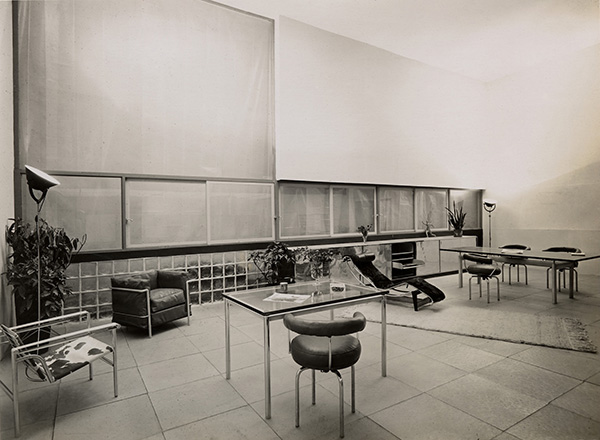
| Le Corbusier, Pierre Jeanneret, Charlotte Perriand, Un équipement intérieur d’une habitation (Autumn Salon), 1929, Archives Charlotte Perriand. Photo: Jean Kollas, Image Archives Charlotte Perriand/VG Bild-Kunst, Bonn, 2025. |
An Impressive Exhibition
Not only was she denied authorship of these four chairs, but her architectural work beyond the collaboration with Le Corbusier also faded from view. The impressive exhibition Charlotte Perriand: L’Art d’habiter / The Art of Dwelling, which opened in early November at the Kunstmuseen Krefeld, proves that this is unjustified. The exhibition was curated by Katia Baudin and Waleria Dorogova, in close collaboration with Pernette Perriand, Charlotte’s daughter, and Jacques Barsac.
The exhibition demonstrates that Perriand’s designs of the 1920s and 1930s were widely appreciated, both in the press and among her peers. The idea that she was ignored until rediscovered by feminist scholars has already been debunked as a myth by architectural historian Mary McLeod. Perriand herself never saw herself as a victim. She told McLeod that Le Corbusier supported her and gave her the opportunities she needed.
The exclusion that did occur happened later. Retroactively, museums stripped female designers such as Perriand of their authorship and pushed their contributions into the background. Only very recently has a process of re-evaluation begun, giving female partners the recognition they deserve. A major example of this reassessment was the exhibition Buone Nuove / Good News at the MAXXI Museum in Rome (2021/2022).
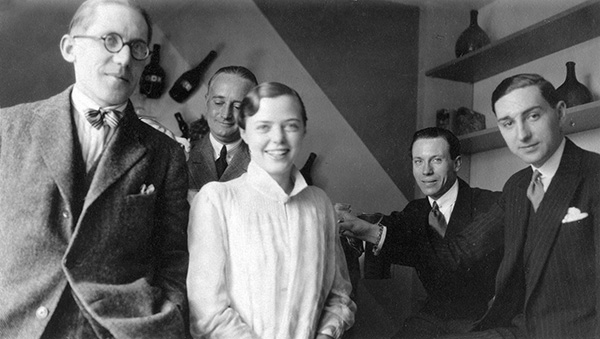
| Group portrait with Le Corbusier and Charlotte Perriand, 1928. Photo: Pierre Jeanneret, Image VG Bild-Kunst, Bonn, 2025. |
The Architecture Office as a Pyramid
One of the first architecture books I ever bought was a Thames & Hudson pocketbook by Werner Blaser on the work of Ludwig Mies van der Rohe. At the beginning of the book, there was a photo of the great architect sitting relaxed in one of his own chairs, cigar in hand. The image implicitly reinforces the notion of a man in charge, directing all projects and lending his name to the office.
This is no longer the only possible structure for an architectural practice. Although offices built as pyramids with one or more partners at the top have not disappeared, a range of alternatives has emerged over the past 30–40 years. During this period, architectural duos—working closely together professionally and personally—have become more prominent, as have flexible architectural collectives.
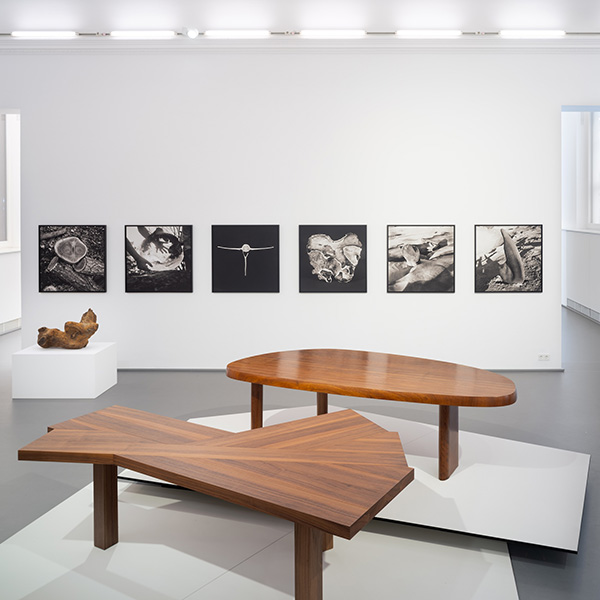
| Exhibition at Kaiser Wilhelm Museum Krefeld, 2 Nov 2025 – 15 Mar 2026, Image Rose. |
The exhibition in Krefeld shows that Perriand based her practice on collaboration. The figure of the solitary, heroic architect who determines everything held no appeal for her. Architecture, in her view, is the result of diverse forms of collaboration, involving a wide range of participants: clients, engineers, consultants, interns, photographers, journalists, politicians, and staff.
From Chair to City
In 1951, the Groupe Espace was founded, pursuing the ideal of a synthesis of the arts. The group sought to unite art, architecture, and urbanism to create a modern, humane environment in which art would form an integral part of public life. Perriand was part of this collective, whose aim was to secure major public commissions from the French government.
In this context, she designed the interior of the Maison de la Tunisie in Paris, a building by Jean Sebag. Perriand worked closely with Jean Prouvé on its execution. She furnished 40 of the 126 student rooms and designed the common areas, including the cafeteria, reception hall, lounge, director’s office, laundry room, and garden. She also designed a bookcase together with other collective members, for which Silvano Bozzolini created the colour scheme. In this project, Perriand combined functional design with a refined spatial sensibility.
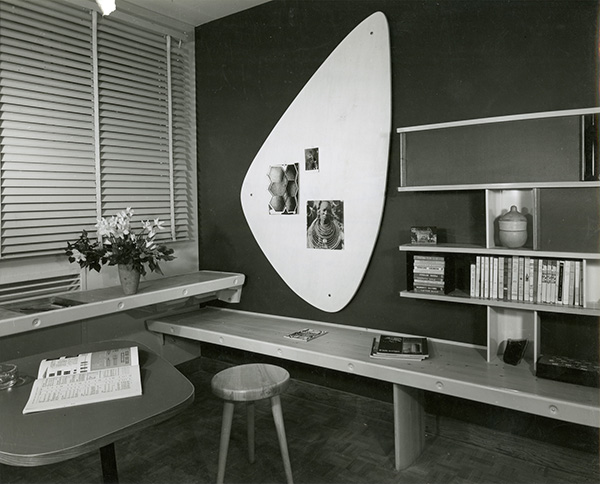
| Charlotte Perriand, Jean Prouvé, Student Room, Maison de la Tunisie, Cité Universitaire Internationale de Paris, 1952. Photo Sabine Weiss, in L’Architecture d’Aujourd’hui, 1953, Image Archives Charlotte Perriand (AChP). |
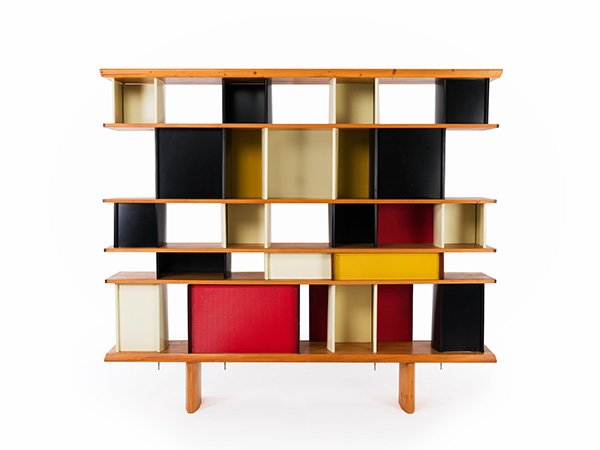
| Charlotte Perriand, Mexique bookshelf, 1953, Musée d’Art Moderne et Contemporaine de Saint-Étienne Métropole, Image VG Bild-Kunst, Bonn, 2025. |
Organic Style
Her Bar sous le toit (Bar under the Roof) in Paris consists of an extendable dining table with steel legs, red leather chairs, and cabinets with mirrored fronts. This interior reveals Perriand’s priorities: optimizing space and comfort. Her interiors carefully address the conditions of urban life.
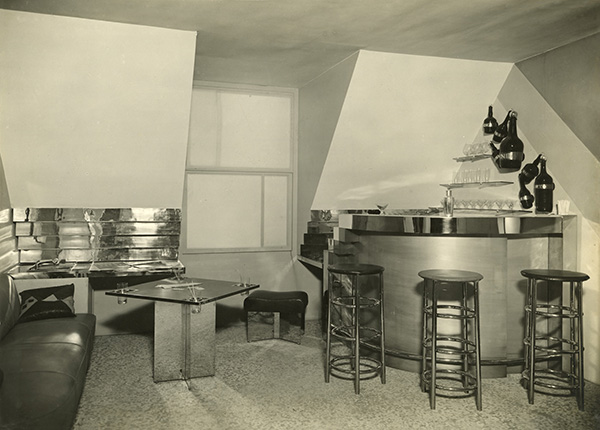
| Charlotte Perriand, Bar sous le toit, 1927, Image Archives Charlotte Perriand/VG Bild-Kunst, Bonn, 2025. |
The many years she later spent in the Far East (Japan, Vietnam) led to a reorientation in her work. She moved away from the machine aesthetic that had dominated her early designs and towards a more organic style. In 1938 she created the Forme-Libre table, recycling panels from the 1937 World Exhibition.
She increasingly drew inspiration from the simple forms she encountered in the vernacular architecture of rural areas, aligning herself with a rich tradition of regional building cultures. In the Refuge Bivouac, which she designed in 1938 with André Tournon, she reinterpreted traditional building elements in a modern way.
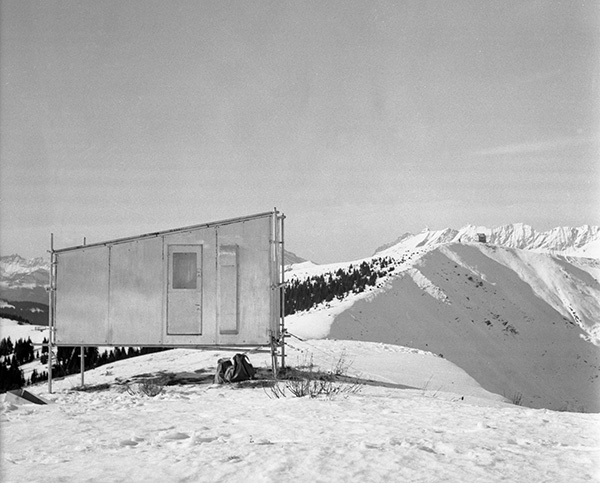
| Charlotte Perriand, André Tournon, Refuge Bivouac on Mont Joly, Saint-Nicolas-de-Véroce, winter 1938/1939, Image Charlotte Perriand, Image Archives Charlotte Perriand / VG Bild-Kunst, Bonn, 2025. |
Compact Living Unit
The issue of minimal living space was central to many architectural debates in the 1920s and 1930s. Questions included: How much space does a person need to live? What qualities can be given to such a reduced space? These questions resurface today in discussions on housing shortages, urbanisation, and social reform.
Perriand designed the Cellule—a compact living unit based on functionality and rational use of space. This housing cell is a prototype that can be adapted to any context or need. From this model, Perriand developed emergency housing, student residences, and holiday homes. A splendid example of the latter is the holiday village she designed in the 1960s for developer Roger Godino in the French Alps.
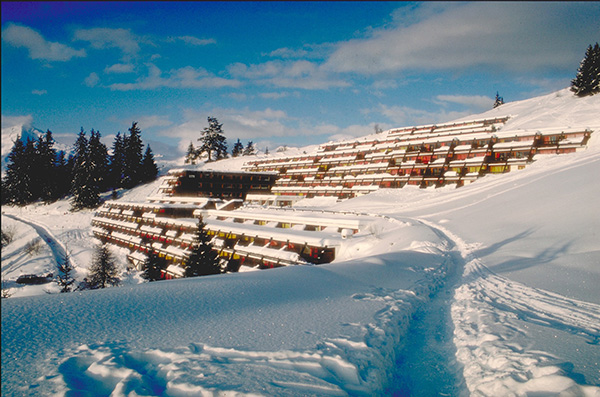
| Charlotte Perriand, ARC 1600, south slope, design 1968, Les Arcs, France, Photo Pernette Perriand, Image Archives Charlotte Perriand (AChP)/VG Bild-Kunst, Bonn, 2025. |
Humanism and Engagement
Perriand consistently demonstrated strong social engagement. She embraced communist and Marxist ideas and remained committed throughout her life to a humanistic approach to design. As an architect, she sought to translate her social convictions into her projects.
She does this most explicitly in a photomontage shown in Krefeld. The Great Misery of Paris (1936) documents the social hardships and urban challenges faced by Paris between the wars. The collage combines newspaper photos, maps, documentary images, and typographic elements into a layered visual indictment.

| Charlotte Perriand, La Grande Misère de Paris, Image Archives Charlotte Perriand/VG Bild-Kunst, Bonn, 2025. |
In 1933 she participated in the fourth CIAM (Congrès Internationaux d'Architecture Moderne) congress on the functional city. Secretary Siegfried Giedion later remarked that the congress was a successful attempt to assert the legitimacy of modern architecture against the conservative building culture of the time. For Perriand, it marked the beginning of her long-term commitment to mass housing.
The Need for a New Humanism
The exhibition in Krefeld is compelling for many reasons. It corrects the image of Charlotte Perriand as a designer merely in the service of Le Corbusier. It also shows that Perriand was not only a designer, but very much an architect—one who worked across all scales, from the chair to the city.
According to the exhibition’s curators, Perriand’s vision of minimal living remains just as relevant today. They cautiously suggest that her work could once again serve as a model for a modern, humane, and sustainable life in and with limited space. There is merit in that suggestion, but Perriand’s humanism is equally compelling.

| Charlotte Perriand on a ski holiday in Japan, 1941, Image Archives Charlotte Perriand / VG Bild-Kunst, Bonn, 2025. |
She shared a dream of global prosperity and emancipation—a dream that soon collided with the realities of socio-economic injustice, climate change, and social conflict. This led some to question her humanism and dismiss it as an “elitist” concern. Yet the paradox is that we live in a future she anticipated and helped shape, while we ourselves have now lost sight of that future.
Today, the future is no longer seen as a life one must learn to live, but rather as a problem to be solved through science and artificial intelligence (AI). There is a great need for a new humanism that reverses this perspective—one that restores priority to human life and its kinship with other species.
Exhibition
The exhibition Charlotte Perriand: L’Art d’Habiter / The Art of Dwelling is on view until 15 March 2026 at the Kunstmuseen Krefeld. It is spread across three locations: the Kaiser Wilhelm Museum and Haus Lange, Haus Esters. The latter two buildings were designed by Ludwig Mies van der Rohe and handed over to the museum in the 1960s. The exhibition will later travel to the Museum der Moderne in Salzburg and the Fundació Joan Miró in Barcelona.
About the Author
Harm Tilman (1954) is curator of the independent blog VivaArchitectuur.nl that explores topics related to architecture and the built environment. Previously, he worked as editor-in-chief of architecture magazine de Architect and as curator of the Lensvelt de Architect Interieur Prize and ARC Awards.
Source
This article previously appeared in Dutch on Viva Architectuur and can be accessed via this link.
Posted January 19th, 2026